
Balance: Wealth Planning Due Diligence Report
Due diligence - your responsibilities
Anyone referring their clients to another professional firm naturally wants to take all necessary steps to ensure that introduction is going to be appropriate. Indeed, many regulators and professional bodies are clear that they expect professionals to take responsibility for referrals they make, and carry out suitable due diligence beforehand.
"When making an introduction to a financial adviser, a firm must ensure that it adheres to the requirement to give objective advice as required by the ICAEW Code of Ethics"
(Introductions to financial advisers, ICAEW Technical Advisory Services, February 2020)
"The SRA expects solicitors to be able to demonstrate to clients why they believe a referral to a third party is in their best interests....Your firm must take responsibility and instigate a firm-wide process, to be followed by everyone."
(A safe pair of hands: choosing the right financial planning referee, D Seager, SIFA Professional, published by The Law Society, July 2019)
"How can anyone ensure a referral is in the client's best interest, without first doing due diligence on the third party being referred to?" Crispin Passmore, Solicitors Regulation Authority
(Have you established a firm wide third-party referral process?, D Seager, SIFA Professional, published by Legal Futures, November 2022)





This due diligence report
The purpose of this report is to give you the necessary details about the professional foundations of Balance: Wealth Planning as a business, and key members of our financial planning team. Our aim is to satisfy your requirement for due diligence, giving you confidence that the firm that you are working with shares your values, is robust and resilient, with high standards of client service and integrity.
You can navigate through the different sections by clicking the left hand menu.
On the left hand side, you can also click to save the whole report as a PDF, or to print it, to maintain your professional introductions due diligence requirements.
This report is reviewed and updated when required, so you can revisit it when you need to refresh your due diligence checks.
If you have a question about any aspect of our services, please contact us using any of these methods:

The Point, Loughborough Road, West Bridgford, Nottingham, NG2 7QW
T: 0800 7723456 | team@balancewealth.uk | www.balancewealth.uk

Due diligence checklist
This checklist is designed to help assist your own due diligence framework for the firms you are introducing to your clients. The resources you need to satisfy each area are linked where available, or otherwise contained within this report.
| Tick | Area | Due diligence check |
 | Background, Vision & Key Facts | Firm's history, vision for the future and key facts. Check for an alignment with your own firm's vision and values. |
| Regulatory compliance | Firm and financial planners are listed on the Financial Conduct Authority register and all Financial Planners have a Statement of Professional Standing. Business information and requirements up to date at Companies House. |
 | Independent status | Type of financial planning advice provided. Will any referral to this firm compromise your independence? |
| Business structure and leadership | Business structure, ownership and accountability. All information and requirements up to date at Companies House. Expertise and qualification of senior management team as defined by the FCA's Senior Management and Conduct Regime rules |
 | Security and resilience | Adequate Professional Indemnity Insurance held, alongside sufficient capital resources for the firm and suitable systems and controls in place. |
| Professional standards | Highest recognised status or accreditation of the firm - with Chartered Status being the gold standard. |
| Awards and accolades | Awards and accolades attributed to the firm. |
 | Professional development | Structured ongoing development programme for people delivering the firm's services. This ensures technical knowledge is kept fresh and relevant. |
| Planner biographies | Biographies of key people delivering the firm's services, including their qualifications, expertise and background. |
| Expertise | Breadth of services provided and areas of specialism within the company. |
 | Financial planning process | Typical process and experience for clients. What they can expect before engaging as a client, and what the process looks like from then on. |
| Cost of advice | Fee structure and typical charges for advice, with context against typical charges for the whole profession. |
 | Ideal clients | Typical clients, their circumstances and drivers. When they look for financial planning advice, and what makes a good relationship for them. |
| Client feedback | Client experience and feedback. |
 | Professional collaboration | What working together looks like. |
Background, Vision & Key Facts
Background
Established in 2014, Balance: Wealth Planning was founded to solve a problem. After a number of years as a practicing Financial Planner, Operations and Compliance Director, our founder Rebecca Aldridge had a clear sense of what great financial planning should look like. Importantly, she could also see what was fundamentally flawed in the profession and how it needed to change. She believed the financial planning profession was structured in a way that easily created bias, unethical business practices and poor professional behaviour.
She was not alone. Two years prior, the Financial Conduct Authority had implemented the Retail Distribution Review, with the goal of fundamentally changing the way in which financial advice operated in the UK. It aimed for improved transparency, higher minimum qualifications, and improved clarity of information to clients, particularly concerning the cost of advice. 20% of financial advisers had left the profession completely as a result.
The new regulations had forced firms to take big steps in the right direction, and pushed out a lot of bad apples, but it wasn't enough. Firms and the financial advisers that worked for them were still remunerated as a percentage of the amount a client invested, almost identical to the times when financial advisers had been paid commissions. It sustained the system of cross-subsidy between clients, with some relationships being incredibly profitable and others loss making. Clients investing a great deal were paying for the advice received by those clients investing a more modest amount. Rebecca felt this was unethical and poor business practice.
This method of charging for advice also created structural bias. A financial adviser would be incentivised to invest more than might really be sensible for a client, and for it to stay invested. This bias was present at firm level due of the percentage charging approach, but also at the level of the individual financial advisers, who continued to be measured and remunerated based on targets which largely related to the amount their clients were investing
Rebecca believed important cornerstones of financial planning going forward would be:
- A holistic approach to financial advice, understanding the whole of any client's circumstances
- Fees based predominantly on time-costs rather than a percentage of any investment
- Goals-based, lifetime financial planning, with clients having a deeper understanding of what their money was for, and the type of lifestyle it could support
The number of firms offering that type of service at the time in the UK was tiny, and most were boutique companies. However, Rebecca was convinced the future of financial planning lay in that direction, and founded Balance: Wealth Planning in 2014 on those principles. By doing this, she was part of a movement away from what had gone before, and towards a new way of thinking about financial advice. For many taking that same journey within the profession, they stopped describing themselves as Financial Advisers, Wealth Managers or IFAs. Instead, they started describing themselves as Lifetime Financial Planners.
Now in 2024, there are many more companies operating in the same way as Balance: Wealth Planning, or trying to move in that direction. Qualifications are more aligned with this way of working, and clients are now more likely to ask for a Financial Planner rather than an IFA. These changes would not have happened if it wasn't for people like Rebecca sticking to their principles, and creating ripples, which eventually turn into waves.
Regulations are also continuing to increase the professionalism of firms and outcomes for clients, with rules around Senior Management Conduct, Consumer Duty and more. Firms like Balance: Wealth Planning feel there is still a long way to go, and are continuing to lead the way.
Vision
Our mission is to positively influence the greatest number of people possible through our expertise as financial planners. There are three threads to our vision:
- Influence the lives of our clients. We use our expertise to help our clients achieve their life goals as quickly and robustly as possible. Our aim is for our clients to feel prepared, in control, fulfilled, with a support system around them, and able to focus on their personal priorities.
- Influence the experience of our team. We maintain an environment as an employer where it's a pleasure to work, and encourage continued professional development.
- Influence the direction of our profession. We use our platform to help other firms move towards using a goals-based financial planning approach, and in particular we support other firms aiming to charge flat fees instead of percentages. This involves talking at professional events, contributing to technical publications and supporting other firms on a 1:1 basis.
Key facts
Independent status 85% of financial advice firms are independent. (1) | Multi-Award winning Top 100 UK Financial Planning company for 5 consecutive years. Best Financial Adviser to work for from 2022 - 2025. | |||
We charge fixed fees £4,800 - £20,000 Average charges for financial advice according to FCA are 2.4% of amount invested initially and 0.8% pa. (2) | Holistic, goals-based approach. Financial planners are accredited Life Planners, trained through the respected Kinder Institute. | |||
| Chartered Financial Planning firm We are among the top 15% of financial advice companies in the UK with this gold-standard status. (3) |  | Two investment portfolio ranges with 10 risk levels, managed in-house: named Core and Good Practice. Portfolios are evidence-based and low cost, with performance consistently close to market benchmarks. Our Good Practice portfolio excludes companies with a harmful impact on society or the environment. | |
| 7 Financial Planners We are among the largest 10% of financial planning firms with our 7 Financial Planners. (4) | | Nottingham head office and clients Nationwide Office facilities in Nottingham and Lincoln and otherwise we serve clients around the UK remotely. | |
| Pension transfer specialists, able to give advice about defined benefit pensions and safeguarded benefits We are among the 23% of firms authorised to advise in this complex area - and many of those choose not to offer this as a service. (5) |  | 4 of our 7 financial planners are female. 100% of board are female or from a minority ethnic background. With women making only 16% of all financial advisers in the UK, we have a significantly higher representation. (6) |


(1) https://www.statista.com/statistics/317905/number-of-financial-advisers-in-the-united-kingdom-uk/
(2) https://www.fca.org.uk/publication/corporate/evaluation-of-the-impact-of-the-rdr-and-famr.pdf
(3) https://www.cii.co.uk/membership/join-us/chartered/
(4) https://www.fca.org.uk/data/retail-intermediary-market-2019
(5) https://www.fca.org.uk/data/defined-benefit-pension-transfers-market-data-october-2018-march-2020
(6) https://www.ftadviser.com/your-industry/2022/07/13/fca-data-shows-just-16-of-advisers-are-women/
Balance: Wealth Planning Regulatory Position
Regulator and professional body memberships
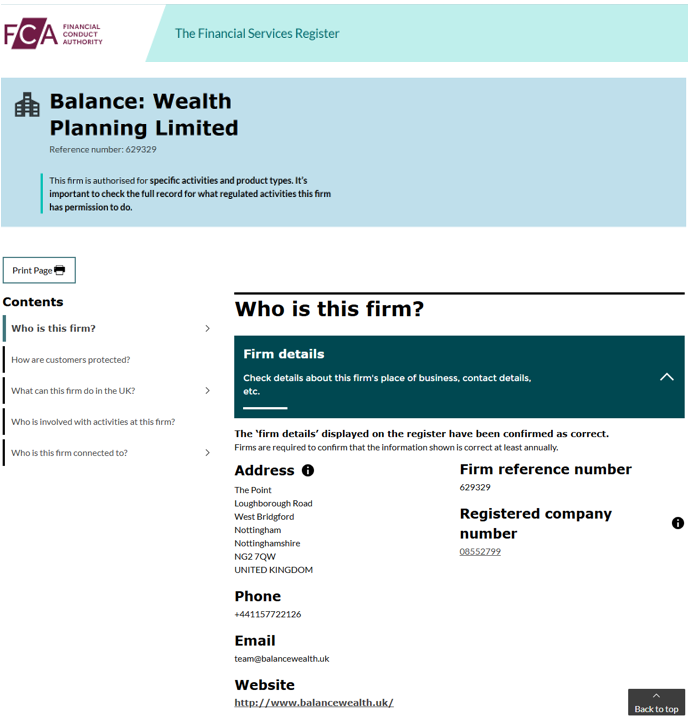
Our regulator is the Financial Conduct Authority (FCA). All firms and individuals are registered on the FCA register which is available to consumers. We are registered under reference 629329: https://register.fca.org.uk/s/firm?id=001b000000a8GfdAAE
The FCA register will show you a page with content similar to the extracts below. It shows how we are authorised, in what areas we can give advice, and links to our senior management team. This is the first page from the register. Please access the register itself to read the whole listing.
Statement of Professional Standing
Every financial planner in the UK must have a Statement of Professional Standing. It is issued by their professional body and renewed every year, when they are satisfied the individual is meeting standards in:
- Required minimum qualifications to practice as a financial planner
- Ethical practice
- Continued professional development
- Being a fit and proper member of the financial planning community
Our financial planners all have a current Statement of Professional Standing certificate. You can look up their current certificates in their Adviser Packs, which are linked further within this report.
Professional body memberships
We are also members of professional bodies which reinforce our ethical standards and practices, either on a firm-wide basis, or as individual financial planners:
- Personal Finance Society, part of the Chartered Insurance Institute
- Chartered Institute of Securities & Investment
- London Institute of Banking & Finance
- Society of Trust and Estate Practitioners
Independent status
Independent status
"Independent" and "Restricted" advice are regulatory terms used to differentiate the types of regulated financial advice which firms provide. The difference between the two can be difficult to spot initially as it is not often mentioned in marketing material. It can also be a challenge for consumers and trying to assess the benefits and drawbacks of each option.
| Independent Advice | Restricted Advice |
Not limited by company, investment solution or area of planning, sometimes called "whole of market", and therefore able to see the full landscape of planning needs and solutions:
| Can take a few forms, but the common theme is that it always includes a limitation of some type, usually:
|
Balance: Wealth Planning Limited is independent in each area of financial planning that we provide.
This means we can recommend any regulated product or investment for our clients, based on what is most suitable for them. We are independently owned, so there is no requirement or expectation for us to recommend solutions that might be be provided by a parent company.
Most professions expect referrals to be made to independent financial advice firms, most of the time.
"ICAEW expects that, for most firms and most clients, an independent financial adviser will offer the most suitable and objective advice."
(Referrals to financial advisers: staying compliant, ICEAW, October 2022)
Until 2012, the legal profession was also clear that referrals should only be made to an independent financial adviser. When their governing rules changed, the Solicitors Regulation Authority permitted referrals to either an independent or restricted financial adviser, provided that was in the best interests of the client.
However, the Law Society took the unprecedented step to urge solicitors to continue only referring their clients to independent financial advisers.
"The provision of independent advice has been one of the fundamental tenets of the profession. As such we would urge solicitors to disregard the liberalisation of the handbook in this area and continue to only recommend IFAs." Desmond Hudson, Chief Executive of the Law Society
(Society condemns new rules on IFAs, Law Gazette, November 2012)
When it comes to particular types of pension advice where there are safeguarded benefits, only independent financial advisers are permitted to give advice, under the rules of the Financial Conduct Authority. This includes any advice about Defined Benefit pensions, or pensions with valuable guaranteed annuity rates. We are specialists in this area.
We utilise experts, within our team and externally, to assess and review the numerous product offerings in the market and the numerous investment strategies to fulfil planning needs. We have steps in place to challenge our thinking and to ensure that we evolve our proposition.
Risks of a referring to a restricted adviser
Firms choosing to operate as restricted adviser do so for various reasons, ranging from simplification and cost savings for the firm, to integration with other connected elements of a group of companies such as investment management.
To recap, their restrictions can be found in different areas, including:
- Product restriction: Not being able to recommend the full range of regulated financial products. For example, being able to recommend an ISA but not able to recommend a Self Invested Personal Pension.
- Company restriction: Being limited to recommending financial products offered by their own company. For example, an adviser from St Andrew's Bank may be able to recommend the St Andrews investment portfolio, but not an investment portfolio from any other company.
- Other restrictions: Being limited to a small range of regulated financial products from different providers. Even though there may be no limitations per se by product or company, if the range on offer is not sufficiently broad, this will also be classed as restricted advice. For example, an adviser from ABC Planning may be able to recommend all types of financial product from the St Andrews and St David's range, but not from any other sources.
The accounting profession is clear about what they perceive to the be risk of recommending a restricted financial adviser.
"The principal threat to objectivity in making an introduction to a restricted financial adviser is that clients might be materially disadvantaged by not being offered the most appropriate choice of product."
(Introductions to financial advisers, ICAEW Technical Advisory Services, February 2020)
The Solicitors Regulation Authority was keen to remove any limitations when they last updated their guidance, relaxing their rules to allow solicitors to make referrals to either independent or restricted financial advisers. They put the onus on the solicitor to make sure they are satisfied that referral meets their client's needs, and that they fully inform the client in advance of any restrictions on the product range, and if they are to receive any fee as a result of the referral.
However, this approach has fierce critics about the impact on the reputation of solicitors:
"It is unfortunate that solicitors, who are in no position to distinguish between the respective merits of different categories of adviser, are to be subjected to approaches by those whose advice is conflicted by self-interest. There is a substantial risk that the reputation of the profession will suffer." Ian Muirhead, Chairman of SIFA
(Society condemns new rules on IFAs, Law Gazette, November 2012)
The Law Society itself was also concerned about the risk of becoming embroiled in mis-selling scandals:
“The inevitable consequence will be that solicitors may become more open to negligence claims based on that recommendation or referral" Desmond Hudson, Chief Executive of The Law Society, November 2012.
(Society condemns new rules on IFAs, Law Gazette, November 2012)
With these concerns, our experience is that most professionals prefer to refer to a fully Independent financial planning firm. This minimises their own professional risk, maintains their own independence and will usually be in the best interests of their clients.
Business structure
There are two companies in the Balance Group. Balance: Wealth Planning Limited is our financial planning business. Prior to receiving FCA authorisation in November 2014 it traded under the name Think Smarter Consulting Limited and changed name when the FCA granted its authorisation for us to start offering financial planning advice.
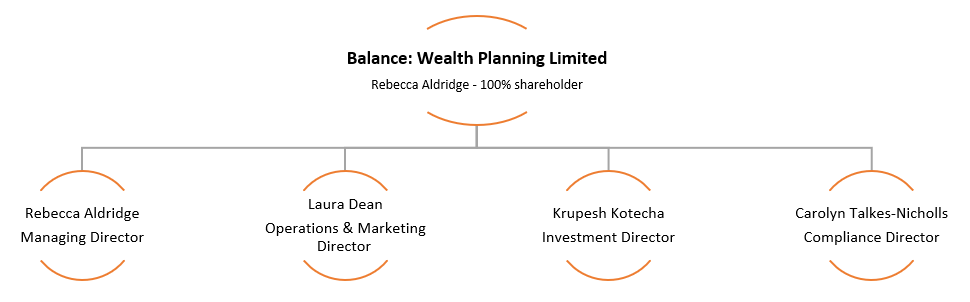
The second company in our group is Balance: Trustees Limited. This is a non-trading company and has no assets or liabilities. Its purpose is to act as a corporate trustee when required. 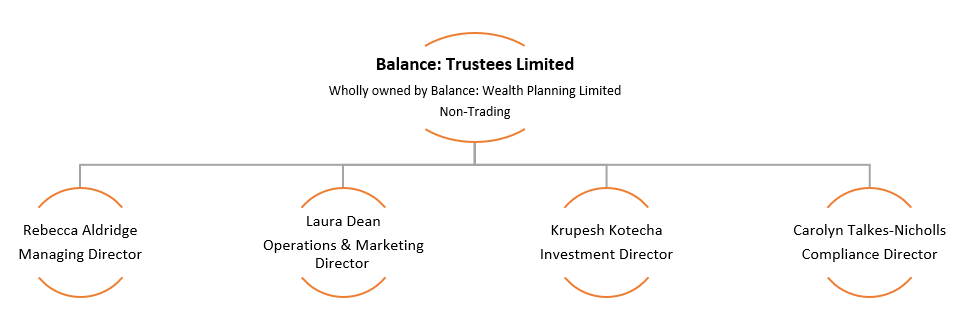
Until recently we operated a small business called Neon Financial Planning, wholly owned by Rebecca Aldridge. This was intended to serve younger clients with a different type of financial planning service. However, having tested the market we decided not to progress further with the concept at this time. The company had operated under the umbrella of Balance: Wealth Planning's FCA authorisation, which also provided administrative support. The business assets are being transferred to Balance: Wealth Planning and the company is being wound up. It has no liabilities or issues regarding regulatory complaints.
Senior management team



- Rebecca Aldridge - Responsible for the development growth and advancement of the business. Financial and technology oversight. Chartered Financial Planner (PFS), Certified Financial Planner (CISI), Pension Transfer Specialist, Financial Life Planner.
- Krupesh Kotecha - Responsible for our investment proposition. Chair of Investment Committee. Chair of Research & Planning Committee. Diploma qualified Financial Planner (PFS), Pension Transfer Specialist, Financial Life Planner.
- Carolyn Talkes-Nicholls - Responsible for compliance oversight for the business, including training and competency of the team. Diploma qualified Financial Planner (PFS).
Companies House records
All reporting requirements for both companies are up to date with Companies House. You can view our latest information using the links below:
Security & Resilience
A great number of our systems and controls are linked to ensuring the business remains resilient and robust. Here are the key areas where that is evident:
- Professional indemnity insurance - We hold £1,850,000 of PII cover and are insured for all advice given since inception. This meets the FCA's requirements. Our policy details are reported to the regulator, the FCA on a six monthly basis.
- Capital resources requirements - The FCA specify a sum that all financial advice companies must hold in cash (or readily realisable assets) to effect an orderly wind-down if ever required, without causing undue harm to their clients. We assess and report this to the FCA every six months. We hold approximately 4x the required capital resources at any time.
- Business risk management plan - We have a risk management plan with weighted assessment of key business risks. This is reviewed across the senior management team on a quarterly basis.
- Conflict of interest policy - We have a suitable policy to proactively identify, monitor and manage any potential or emerging conflicts of interest, such as clients going through separation and divorce. All members of the team must read this policy and complete a yearly declaration to that effect.
- Business continuity plan - A formal strategy is in place to deal with the ongoing functions of the firm in the event of the temporary, long term or permanent loss of key individuals, technology or business premises. This includes delegation of senior management responsibilities, insurances and key operational functions.
- Employed financial planners - All our financial planners are employed by the firm. None of our team are self-employed. This significantly reduces the likelihood of poor advice and behaviour.
- Fixed fee charging model - Unlike the vast majority of financial advice firms, we charge flat fees. This means our fees can be anticipated per month and easily forecast for years ahead. Our fee income does not usually go down. This makes our business financially resilient - significantly more so than most firms which can suffer a 10-20% reduction in income simply because investment markets have fallen.
- Financial crime prevention - Every client relationship is assessed using market-leading anti-money laundering and politically exposed persons databases.
- Compliance Expertise - We have significant in-house compliance expertise within the Senior Management Team. We also have access to the market leading external independent compliance specialists for another perspective when needed.
- Quality checks - All financial transactions are subject to regular compliance checks to ensure accuracy.
- Continuous best practice and development programme - The whole Balance team has a monthly Best Practice session to identify process or service improvements. The team also have a monthly technical professional development session with subsequent debate and discussion to ensure continued technical growth and competency.
Professional standards
Chartered Status
 Having a Chartered status in any profession is symbol of commitment to professional standards. In the Financial Planning profession it is no different.
We are Chartered through the Personal Finance Society, which is the largest and most well-recognised professional body for financial planners. Having Chartered status demonstrates to clients, other professionals and peers that the firm is at the forefront of the profession, going beyond technical competence into excellence and prioritising client centricity and trust at the heart of everything we do.
Approximately 15% of UK firms hold Corporate Chartered Financial Planner status.

Pension Transfer Gold Standard
We have been acknowledged by the Personal Finance Society (PFS) with the Pension Transfer Gold Standard. It’s a badge that we wear with pride and it’s awarded to financial planning companies that adopt and champion a strong ethical code of conduct for pension transfer advice.

Financial Vulnerability Taskforce
We are part of the Personal Finance Society’s Financial Vulnerability Taskforce. This is an initiative aiming to promote greater understanding, encourage appropriate behaviours and establish good practice regarding consumer vulnerability.
As financial planners, we understand it is our responsibility to ensure we deliver consistency, prioritise our clients’ best interests, and look out for those who find themselves in vulnerable circumstances.
Awards and accolades
Citywire New Model Adviser Top 100 awards
 Citywire's New Model Adviser is a very popular and well respected news publication within the financial profession. They welcome entries from the 5,200+ financial advice firms in the UK. The entry application includes criteria about our investment proposition, financial results, qualifications, training and development programmes, future vision and our impact on the wider profession. The Top 100 are a distinct group of financial planning firms chosen to inspire best practice and success in others.
We have been selected as a Top 100 financial advice firm for 5 years. 2025's Top 100 is released towards the end of the year.





VouchedFor Sunday Times Top Rated awards
 VouchedFor are an independent ratings agency for financial advice and financial planning firms, like Trust Pilot or Trip Advisor. Ratings from reviewers are checked and verified by VouchedFor to ensure they are genuine. Financial planners can use the site just to collect reviews or pay a subscription to be listed publicly, so clients looking for a financial planner can get in touch.
VouchedFor's awards, published in the Sunday Times every year, feature those financial planners with the highest satisfaction ratings from their clients. Rebecca Aldridge has received this award for 2019, 2020, 2022 and 2024.
David Norton Building Excellence Award
 The CISI’s prestigious award is named after one of the founding members of the Institute of Financial Planning and is awarded to one financial planning firm every year that has demonstrated building excellence with their core values, business strategy and passion for financial planning. The process is rigorous, including presentations of business information and future strategy to a panel of experts from the profession. It can only be won once, and we were proud to win this award in 2018.
Professional Adviser's Best Financial Advisers to work for
 Judged by Professional Adviser, which is a popular and well regarded news publication within the whole financial planning and investment profession. The application process is rigorous and includes insight into our approach to wellbeing, our development programme, our impact on the profession and the community. A survey of all team members is part of the process. A handful of firms are awarded this title every year, and we are proud to have received it for 2022, 2023, 2024 and 2025.
Money Marketing Awards

In 2024, we were proud to be recognised at the Money Marketing Awards, winning both Best Retirement Advice Firm and Next Generation Advice Firm of the Year.
These awards are judged by Money Marketing, one of the most respected and influential publications in the UK financial planning and investment profession. The application process is highly rigorous, involving a detailed written submission followed by an interview stage, and provides deep insight into our advice philosophy, commitment to client wellbeing, adviser development programme, and the positive impact we have on the wider profession and community. Only a small number of firms are selected each year, making this recognition a significant achievement for our entire team.
Professional Development
Each team member is on a bespoke training and development journey.
Maintaining and developing technical skills is integral to the Financial Planners' role, through Continued Professional Development. The basic core requirement is 35 hours annually, with 21 hours coming from structured learning.
The requirements for a Chartered Financial Planner who is a Pension Transfer Specialist usually exceed 55 hours annually.
Every 12 months, Planners submit their learning to the professional bodies, confirming that they have met and exceeded the required levels of learning, following which a Statement of Professional Standing (SPS) is issued. Financial Planners cannot advise clients without a valid SPS in place. Our Planners' SPS' are within their adviser packs.
Our whole team join professional development sessions on a monthly basis to learn about a specific technical area and discuss how that applies to their role afterwards.
Financial Planners
Every Financial Planner in our team has a biography on our website, from where you can also download their Adviser Pack. These due diligence packs set out their qualifications, Statement of Professional Standing, membership of professional bodies and more. Click on each Financial Planner's name to read more.
Each Financial Planner looks after between 30-60 client relationships. They are assisted by our strong team of paraplanners and administrative experts.







Our expertise
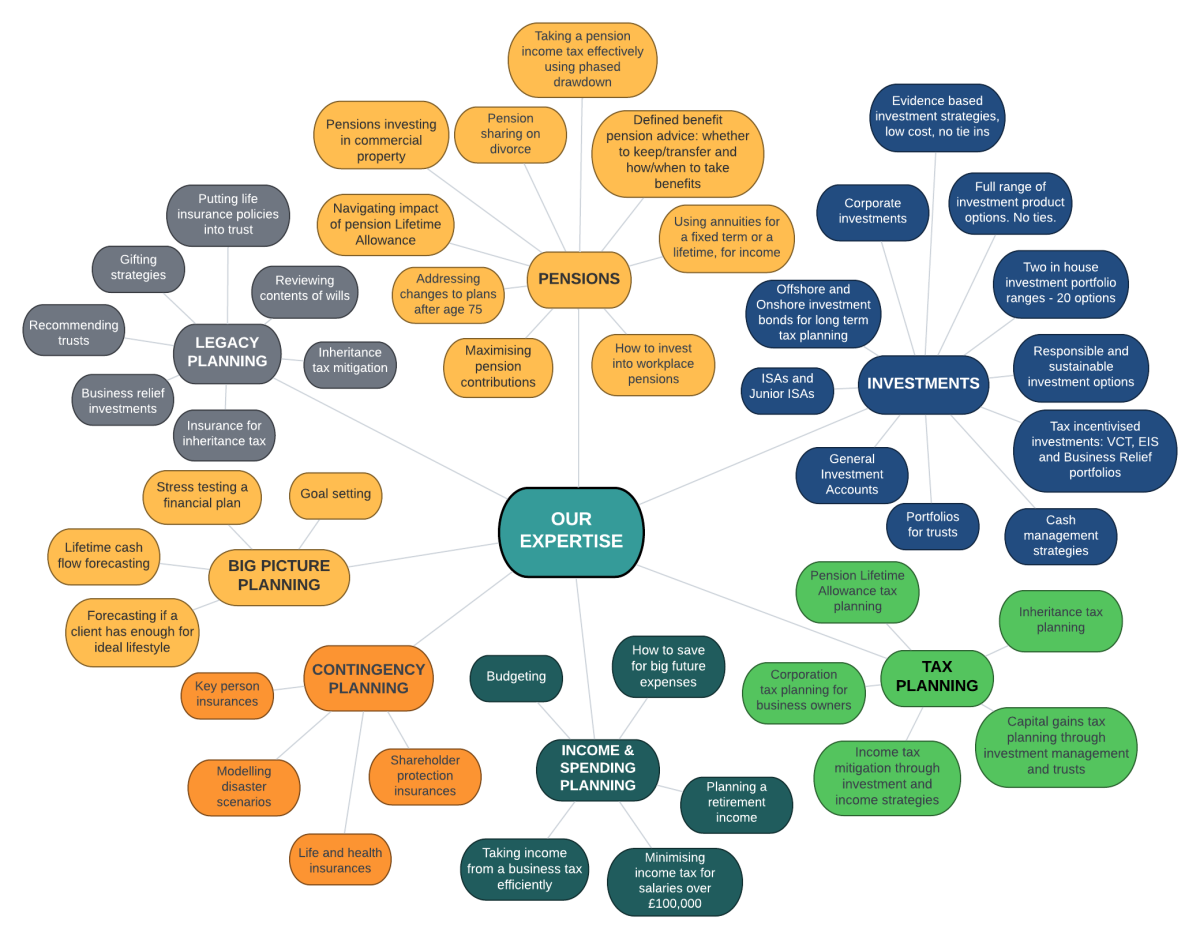
Financial planning requires a specialism in personal investment, taxation and insurance. It also demands a good working knowledge of areas more commonly associated with lawyers, accountants and even counsellors. The infographic below gives an idea of the breadth of expertise we have within our team, which is put to use when we give our clients their financial planning advice.
Financial Planning process
Early stages
When approached by a prospective client, we typically have a free initial consultation meeting in our office or on Teams, lasting up to 1.5 hours. The focus of this meeting is usually the prospective client's main concerns, goals and priorities. We also talk through their current financial situation.
We then arrange a follow up meeting, usually the following week. In that meeting, we present a proposal explaining:
- How we can help
- The areas of planning we feel need most attention
- The cost of our advice
- The financial benefit of taking our advice
- The personal benefit of working with us
- Our terms of engagement
After engagement
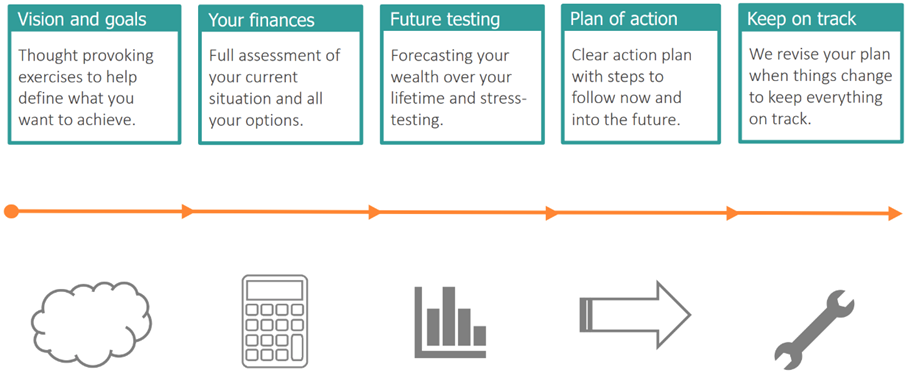
Once our digital terms have been accepted, we take our clients through a planning process as outlined below. We research and compile a personal financial plan and meet with our client to review it together. It takes the form of a written report with bullet point actions, plus review of our online wealth forecasting tool to connect their financial plan with the life goals.
On implementation of the plan, we undertake as much of the work as possible. For most of our clients, we then have an ongoing planning relationship meeting regularly to review the planning and the goals that plan is fulfilling.
Cost of advice
Our Financial Planning advice fees
We charge a fixed fee for our advice at the outset. We also charge a fixed fee for our ongoing planning advice.
Both fees typically range between the limits shown for our Fill Service, depending on our assessment of complexity and approximate time spend to deliver what that client needs. However, we do charge fees above and below this range, depending on the specific needs of the plan.

- These fees are designed to be all-inclusive. We will rarely charge additional financial planning fees on top of this.
- Our fees are not subject to VAT because financial planning advice is usually exempt.
- If we recommend investment portfolios from our own in-house range, these have a management charge which is spread across all investors, of 0.2% of the value.
- If a client requires specific advice about assessing a defined benefit pension scheme, we charge a one off fee for that advice due to its intensity and risk. That fee ranges from £3,600 - £19,250 depending on the pension value.
- All ongoing fees are increased with inflation every year.
- Fees can be paid directly or out of invested capital. Most clients prefer to pay for them out of invested capital. We recommend the most tax efficient route in each case.
Typical fees for advice
According to the Financial Conduct Authority's paper 'Evaluation of the impact of the Retail Distribution Review and the Financial Advice Market Review' (December 2020), the typical cost of financial planning advice from other firms is 2.4% of the amount invested initially, plus 0.8% pa.
For a client investing £500,000 that's an initial advice fee of £12,000 plus £4,000 pa.
For a client investing £2,000,000 that's an initial advice fee of £48,000 plus £16,000 pa.
For a client investing £5,000,000 that's an initial advice fee of £120,000 plus £40,000 pa.
In contrast, our fees do not have a direct relationship to the amount a client invests. They range from a typical £4,800 - £20,000 depending on complexity.
Guidance package
We provide a different type of service for those clients who don't need regulated financial advice, or need it irregularly. We call that our Guidance package. With this service, clients pay a fixed monthly fee of £155 which provides them with support during the year, and a review of their situation once a year. However it does not provide any regulated advice. Should they need regulated advice, or another service outside of the standard Guidance package scope, we charge an addition fee based on a published menu of services.
This service is designed for those who have less than £250,000 invested.
Ideal clients
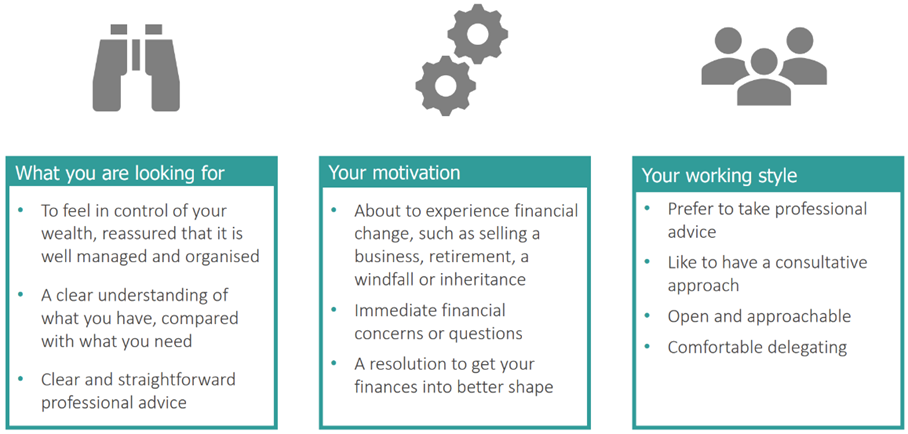
Our typical client is someone who has some complexity to their financial situation and who is keen to have a collaborative professional working relationship. They are usually moved to get in touch because they are about to face a big financial decision or crossroads in their lives.
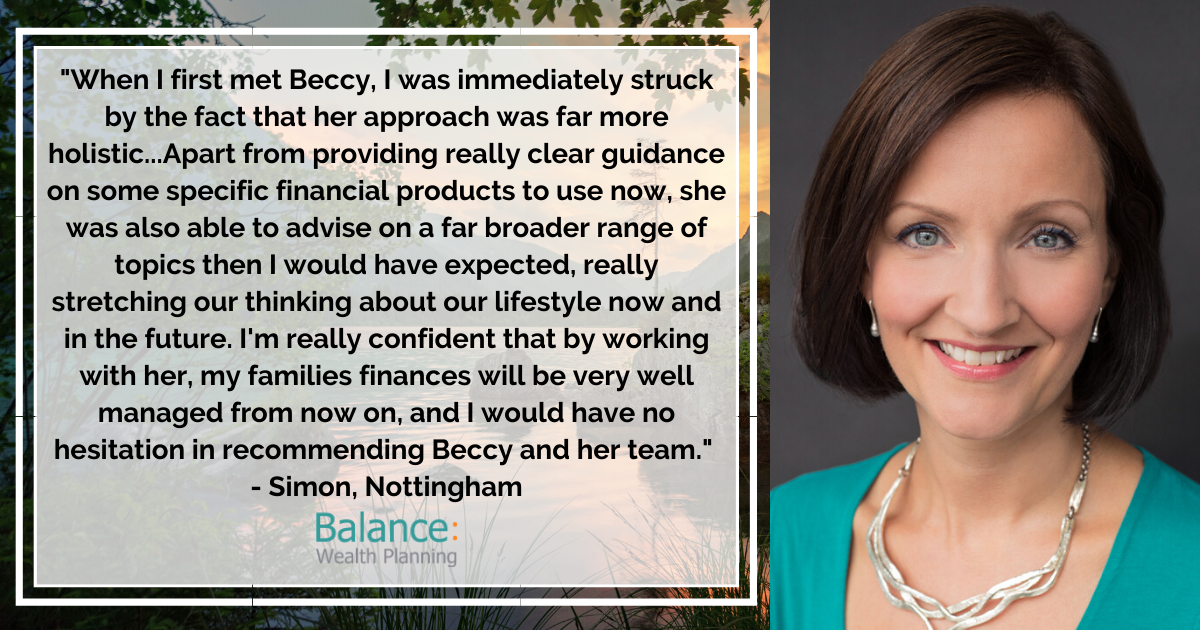
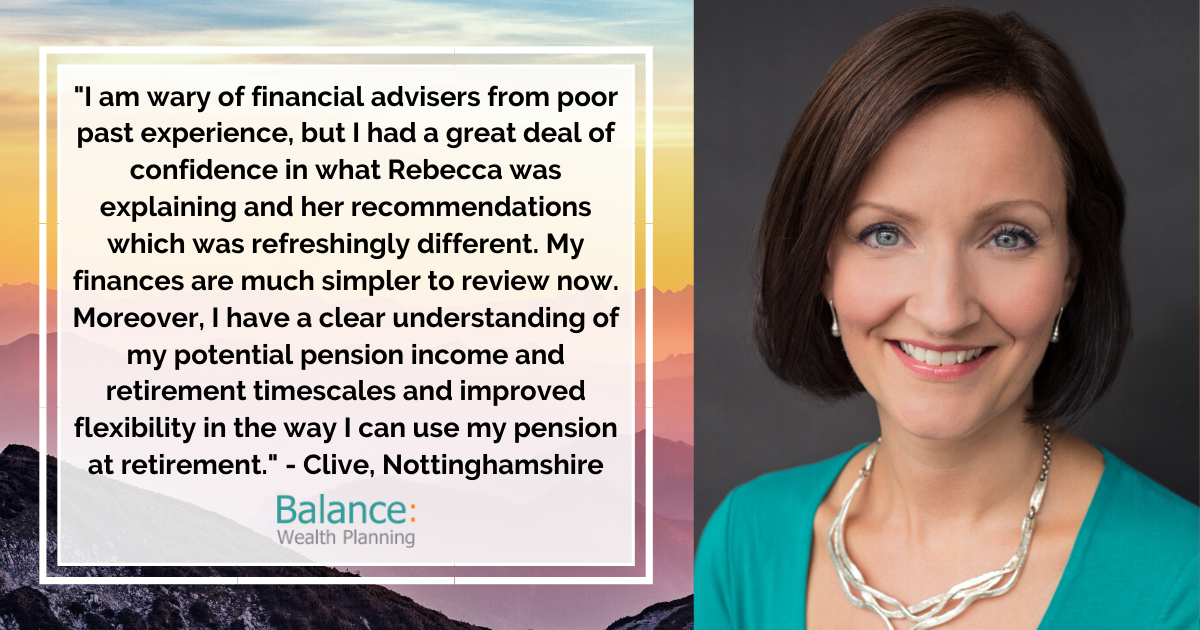
Client feedback



Professional collaboration
Collaboration
Our initial and ongoing planning often works best by collaborating with other professionals. We refer to a select number of firms who we have built relationships with, based on mutual respect, trust and a synergy in what good client service looks like. We underpin that with undertaking initial and ongoing due diligence.
We understand that introducing a new professional to a valued client relationship can bring valuable benefits to the client, where there are shared values and a common ethos.
We expect and welcome due diligence requirements from the firms who introduce us to their clients.
How to introduce us
You can introduce us to a client in a few ways, depending on what works best for you and them;
- We can join a meeting you are having with the clients, where interaction with financial planning is expected
- You can give the client our contact information
- You can give us the client contact information, with their permission, and we'll contact them
We can keep you directly informed throughout the planning process, with our mutual clients' permission.
Commercial arrangements
We do not accept any kind of income share, fee share, commission, introductory bonus or similar.
We also do not pay any kind of fee share or introductory bonus to professional contacts who refer their clients to us.